Bank advisor reviewing an income overview on a laptop with a client

Built for Banks and Lending Teams

Income Verification Software for Banks

WealthCheck’s income verification software for banks verifies borrower income, reduces manual document reviews, and assesses repayment capacity using financial documents and consent-based banking data. Give lending teams structured financial and risk insights within their existing workflows.

Built by Bluem and trusted by international financial institutions, institutional lenders, and regulated platforms.

Aegon
Vista Hypotheken
Unibet
BMW
MINI
Autogroep Twente
02 Income Verification Challenges

Reduce Manual Income Verification, Fraud Risk, and Lending Delays

Fragmented Income Checks

Banks may already hold customer information in their core systems, yet income verification workflows can still ask customers to provide the same data or documents again.

Repeated data entry

Slower case reviews

Missed discrepancies

Affordability & Variable Income

Gross income may not show a customer’s true repayment capacity, especially when earnings fluctuate or come from several sources.

Affordability gaps

Inconsistent income calculations

More evidence requests

False Income & Document Fraud

Altered financial documents or conflicting figures can give lenders the wrong view of a borrower’s finances.

Inflated income claims

Manipulated documents

Higher lending risk

03 Banking Decision Support

Make Faster Decisions
with Income Verification Software for Banks

Verify the Customer’s Income

Confirm the amount, source, frequency, history, and consistency of earnings declared in the lending application.

Income verification dashboard showing payslip, bank credits and tax return income sources with a verified monthly income of €4,200

Assess Repayment Capacity

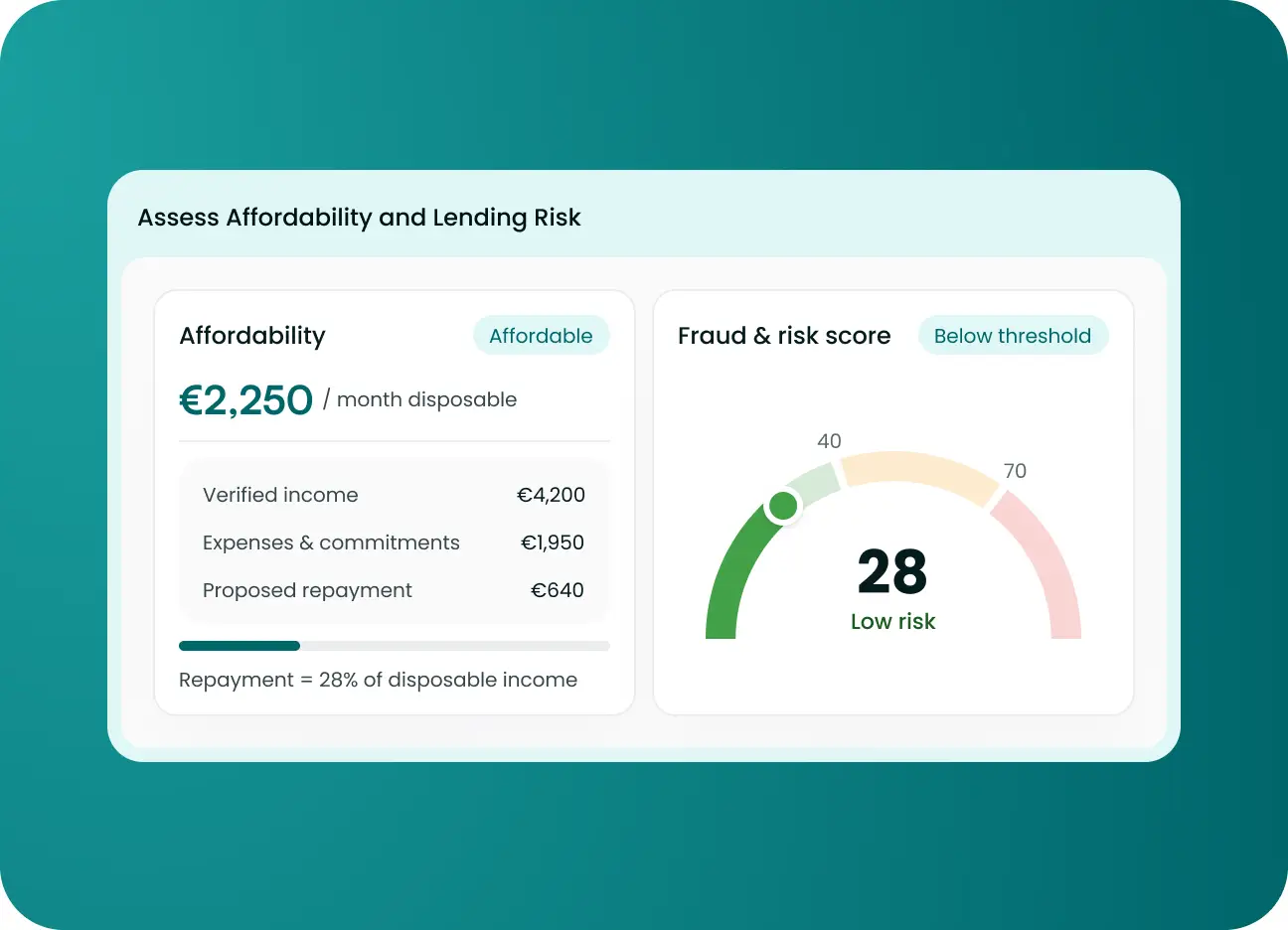
Compare earnings with essential expenses, existing debts, fixed commitments, disposable income, and the proposed repayment.

Repayment capacity chart comparing €4,200 income, €1,950 outgoings and €2,250 disposable income against a €640 proposed monthly repayment

Identify Financial and Fraud Risk

Detect manipulated documents, unusual transactions, conflicting information, and other bank-defined warning signals.

Bank statement under review with a conflicting declared income figure, an unusual cash deposit and a medium risk score of 54

Approve or Escalate

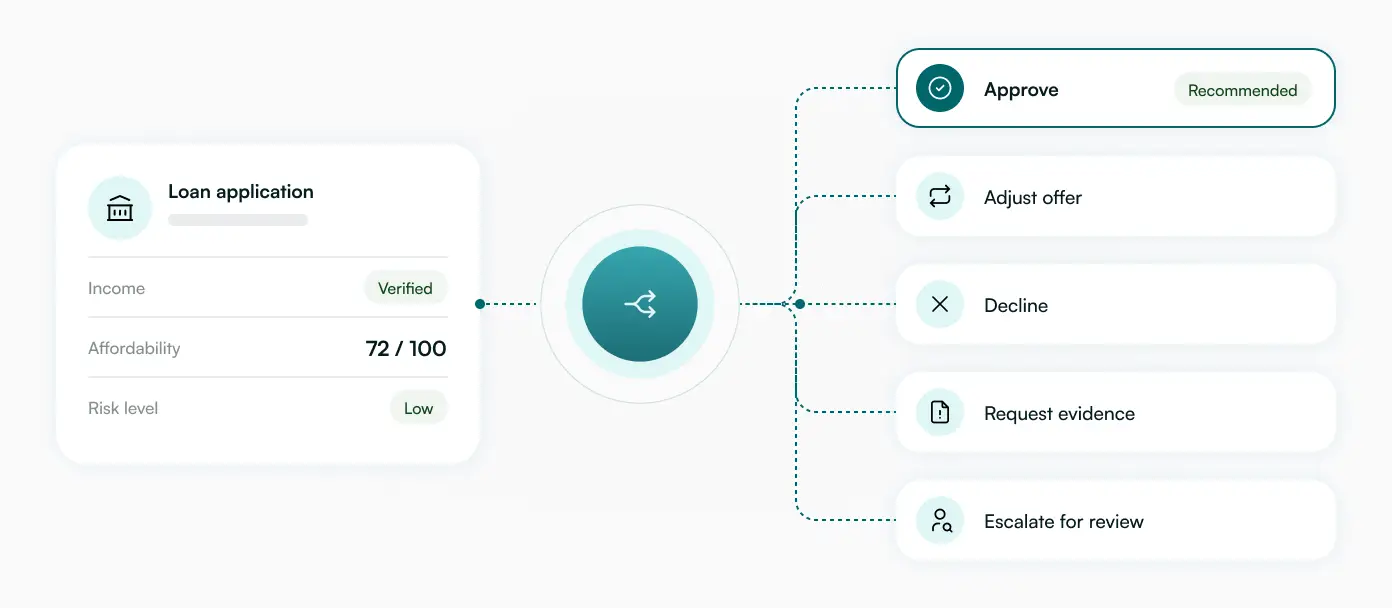
Approve the application, adjust the offer, decline it, request further evidence, or send the case for manual review.

Loan application routed to approve, adjust offer, decline, request evidence or escalate for review based on verified income, affordability and risk level
04 WealthCheck for Banking & Lending

Financial Verification
Tools for Different Lending Requirements

Income Verification

With the income verification API for lenders, review borrower income from different sources and receive the result in a structured format.

Explore More

Affordability Assessment

Review income, expenses, debts, and disposable income to determine whether the customer can afford repayment.

Explore More

Credit Risk Assessment

Bring income, affordability, financial stability, and bank criteria into one risk profile to make loan application review easier.

Explore More

Document Fraud Detection Service

Identify altered payslips and bank statements, duplicate documents, and discrepancies between documents and financial data.

Explore More

Source of Funds Verification

Review the origin of deposits, down payments, business funds, and other financial resources when closer review is required.

Explore More
05 How WealthCheck Works

Build a Decision-Ready
Lending Profile

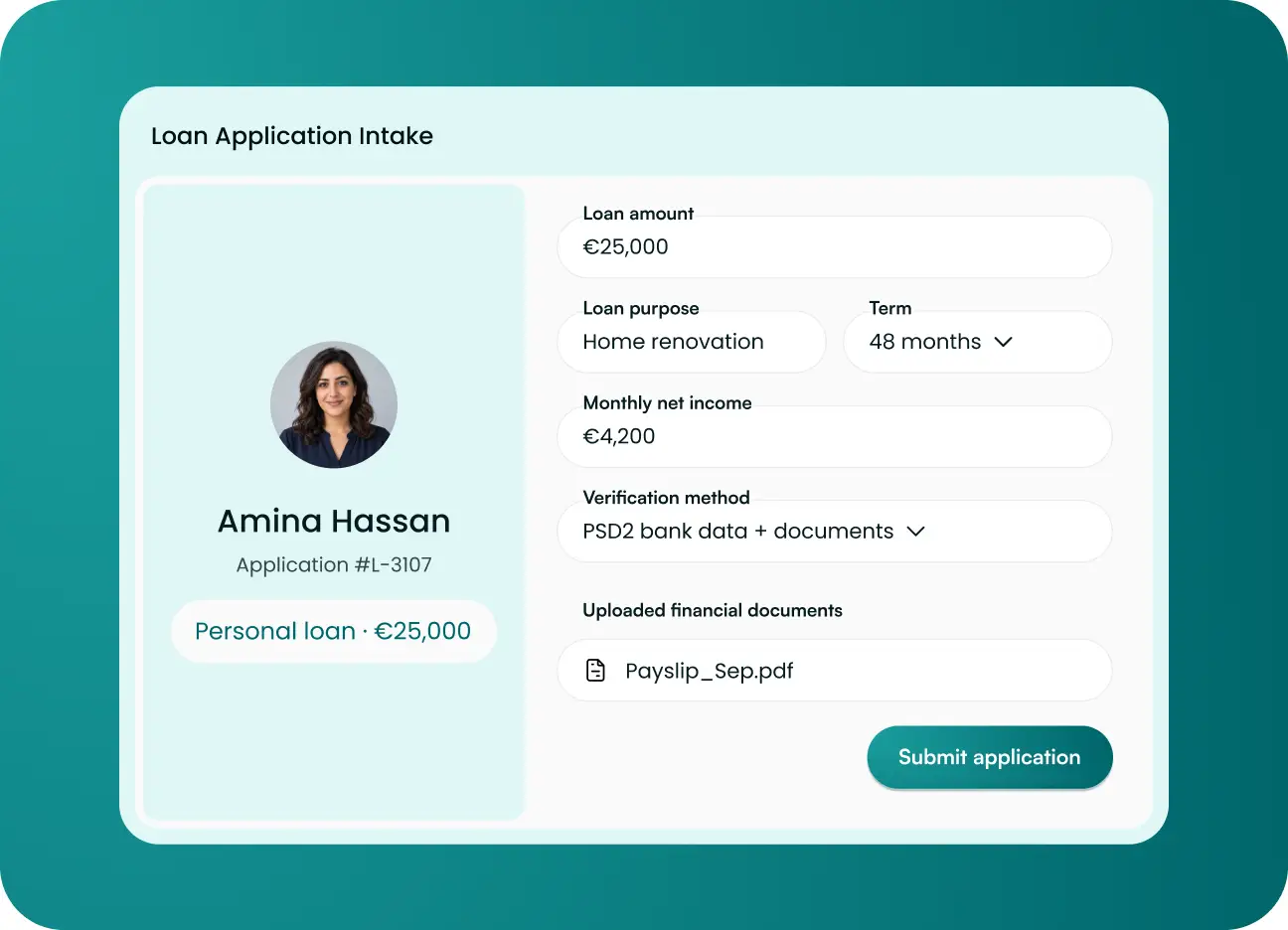
Loan application intake screen with customer profile and financial inputs Bank data, public registers and documents flowing into WealthCheck for income extraction Affordability and fraud risk score dashboard Lending risk report delivered to dashboard, API and webhook
1

Collect Financial and Application Data

To begin, WealthCheck receives application details, financial documents, and consent-based PSD2 banking data through connected banking systems, embedded flows, dashboards, or API integrations.

Loan application intake screen with customer profile and financial inputs
2

Verify Income Across Sources

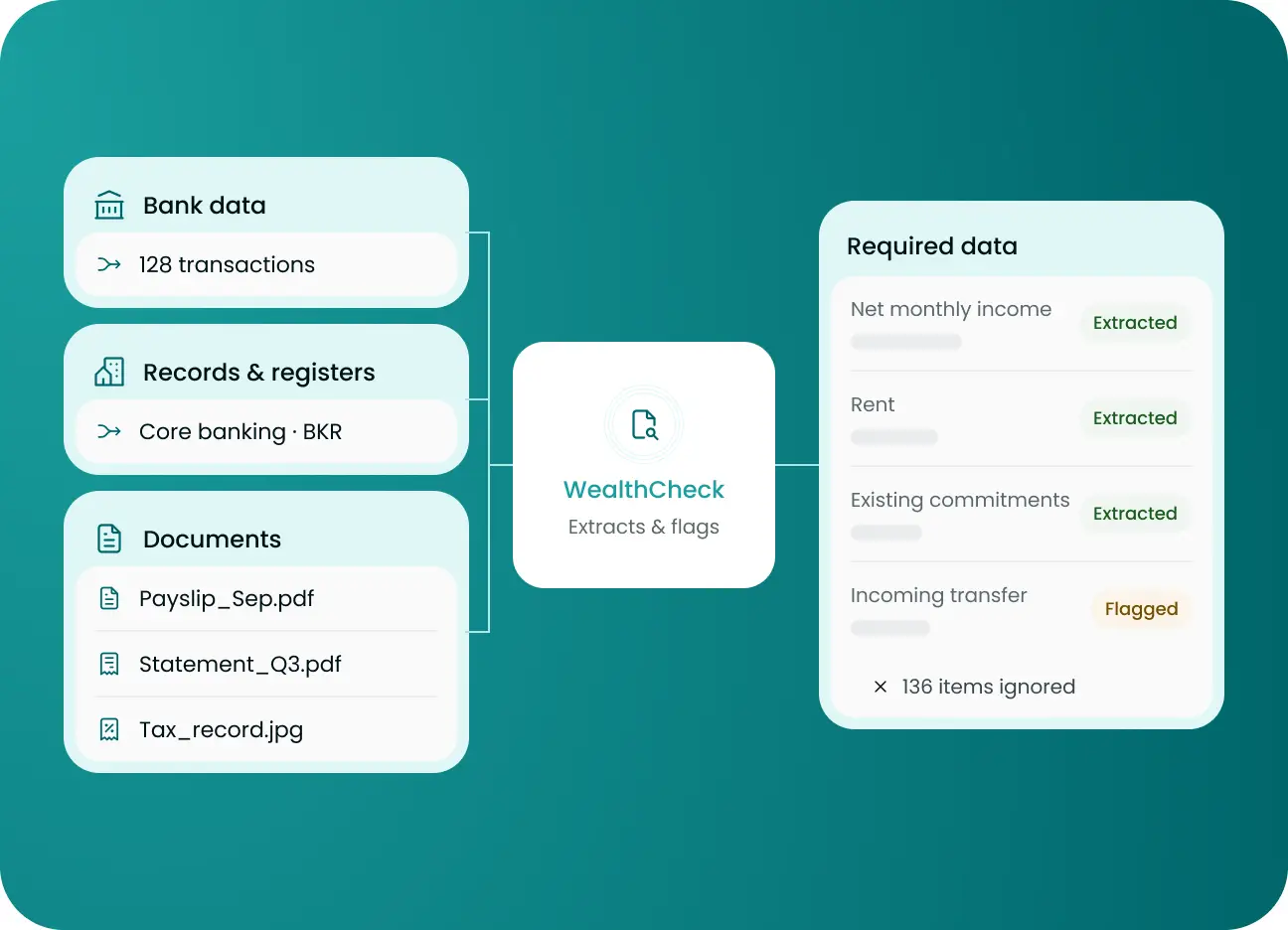
The submitted documents are checked against banking data, internal records, public registers, and other configured sources to confirm the customer’s earnings.

Bank data, public registers and documents flowing into WealthCheck for income extraction
3

Assess Affordability and Lending Risk

The assessment covers recurring expenses, existing liabilities, disposable income, income stability, document integrity, and discrepancies between sources.

Affordability and fraud risk score dashboard
4

Deliver Decision-Ready Results

Finally, verified income, affordability findings, document alerts, risk indicators, and review recommendations are returned through the lending risk assessment API or dashboard.

Lending risk report delivered to dashboard, API and webhook
06 Improve Your Digital Workflow

Automate Digital Income Verification for Banks

Give customers flexible ways to provide financial evidence while your team receives structured income, affordability, fraud, and financial-risk insights within the existing lending journey.

06 Customer Results

Trusted by Banking and Lending Teams

“Variable-income applications used to create a disproportionate amount of manual work for our underwriting team. The new verification flow gives us a much clearer view of income history and consistency, so fewer cases get held up simply because the applicant doesn’t receive a standard monthly salary.”

“Our biggest issue wasn’t collecting documents. It was about knowing whether we could trust what we received. Adding document and transaction cross-checks helped us catch conflicting income figures and suspicious financial evidence much earlier in the application process.”

“We wanted to speed up income checks without forcing our credit team to work across multiple tools. Using an income verification API for lenders gave us a much cleaner workflow: verified financial information now reaches the people making the lending decision without all the back-and-forth we had before.”

08 Decision-Ready Outputs

Everything Needed for
the Lending Decision

Verified Income Profile

The report shows income amount, source, frequency, history, and consistency. It also checks whether declared earnings match the evidence.

Affordability & Disposable Income Result

Shows whether the customer can manage the proposed repayment after expenses and existing commitments.

Expense & Liability Summary

Lists recurring expenses, loans, credit-card payments, fixed commitments, and disposable income. It helps calculate actual repayment capacity.

Document & Data Anomaly Flags

Flags altered documents, conflicting income figures, irregular deposits, duplicate evidence, and undisclosed commitments for further review.

Lending Risk Assessment Result

The final risk classification reflects verified financial information and the bank’s configured criteria, helping determine the application's risk level.

Decision Reasons & Review Status

Each result includes the data, rules, and risk indicators behind the assessment, along with the current review status and any need for additional evidence.

Compliance & Audit Record

Records consent, data sources, completed checks, triggered rules, manual actions, and final status for compliance and audit purposes.

09 Frequently Asked Questions

FAQs about Income Verification Software

How does income verification software for banks fit into an existing lending workflow?

Income verification software connects with digital application journeys, loan origination systems, underwriting platforms, core banking systems, CRM environments, dashboards, and case-management tools. Verification results return to the existing workflow for lending review.

What information does an income verification API for lenders return?

An income verification API for lenders can return verified income data, affordability results, document alerts, financial-risk indicators, and recommendations for further review.

How does a lending risk assessment API use income and affordability data?

A lending risk assessment API compares verified income with expenses, liabilities, disposable income, income stability, and the bank’s risk thresholds to produce a lending-risk result.

Which data sources are used by digital income verification services for banks?

Digital income verification services for banks can use payslips, salary statements, tax records, bank statements, consent-based PSD2 data, internal banking information, public registers, and other configured sources.

How does WealthCheck verify income for self-employed and variable-income customers?

For variable or self-employed income, WealthCheck checks the available income sources and looks at how earnings change over time.

How does WealthCheck detect altered bank statements and fabricated income documents?

Metadata, document format, bank data, and information from other sources are compared to spot changes or conflicting figures.

What happens when a customer cannot connect a bank account or provide standard financial documents?

If the customer cannot connect their bank account or provides incomplete or incorrect documents, an accurate assessment cannot be completed, and the process may take longer.

How does WealthCheck manage customer consent, GDPR requirements, and financial data security?

Consent is recorded as part of the assessment, and PSD2 bank information is accessed with customer permission, and our system maintains records of accessed data sources and completed checks for compliance and audit purposes.

See Income Verification in Action

See how WealthCheck’s income verification software for banks fits into your lending workflow, from customer data collection to decision-ready results.