
A salary figure entered on an application is only a claim until the organization receiving it has evidence to support it. Income verification checks reported earnings against relevant records for the period and purpose under review.
Relying on unverified income exposes the organization to poor affordability decisions and higher payment risk. Different records also describe income on different bases.
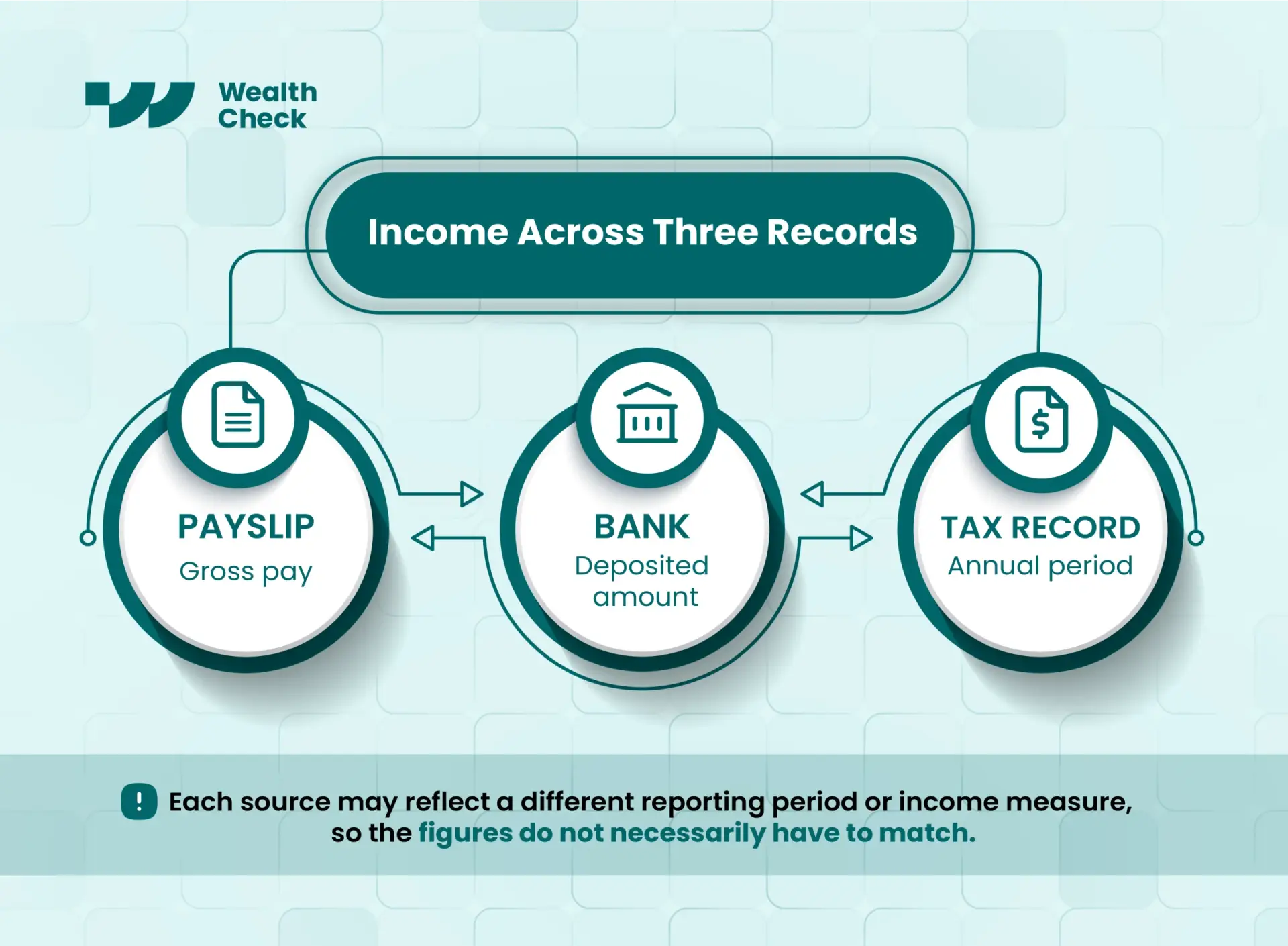
A payslip may show gross pay for one pay period. The bank account records the amount that actually arrived, and a tax return reflects a different reporting period.
Before comparing the figures, the reviewer has to align both the period and the income measure. Employment status and the way income is earned also affect which evidence is useful.
Key Takeaways
These points summarize the main operational differences in interpreting income evidence.
- A verified income figure only makes sense when the evidence covers the same period and uses the same income measure as the claim.
- A high-sales month in a self-employed applicant’s records still leaves the reviewer to determine which portion constitutes the individual’s income.
- If the bank deposit is lower than the payslip figure, check the deductions and payment date before treating the difference as a problem.
- Income verification is one part of a wider financial assessment. The verified figure is considered alongside affordability, existing obligations, financial stability, and broader risk signals before the organization makes its decision.
What Is Income Verification?
Income verification is the process organizations use to verify income against records relevant to a defined period and purpose. The check confirms the amount received to the extent supported by the records. If the payer or activity behind that income matters, the evidence may support the source of income.
Proof of income is the evidence submitted or obtained during the check. A payslip and a bank statement do not prove the same thing, and a tax record usually covers a different period. Employment verification addresses the employment relationship and its status or history.
Some reports include earnings too. Verified income then becomes one input to a later affordability or creditworthiness assessment. Other information shapes the final decision.
Why Is Income Verification Important?
When a decision relies on earnings, the figure needs supporting evidence. A lender uses that evidence in a repayment assessment. Tenant screening and public-program eligibility use income information for different purposes, so the applicable standard comes from the jurisdiction and the decision being made.
- Gross and net figures are different. Gross pay on a payslip is not the same figure as the amount deposited after deductions. Treating them as equivalents creates a false discrepancy.
- The reporting period changes the meaning of the figure. Annual taxable income does not describe the same period as a current monthly payment, so the reviewer has to compare like with like.
Verified income is also distinct from Disposable Income. Income verification establishes what the available evidence supports about earnings. Disposable income refers to the money left after specific deductions or costs and belongs to a different assessment question.
How Does the Income Verification Process Work?
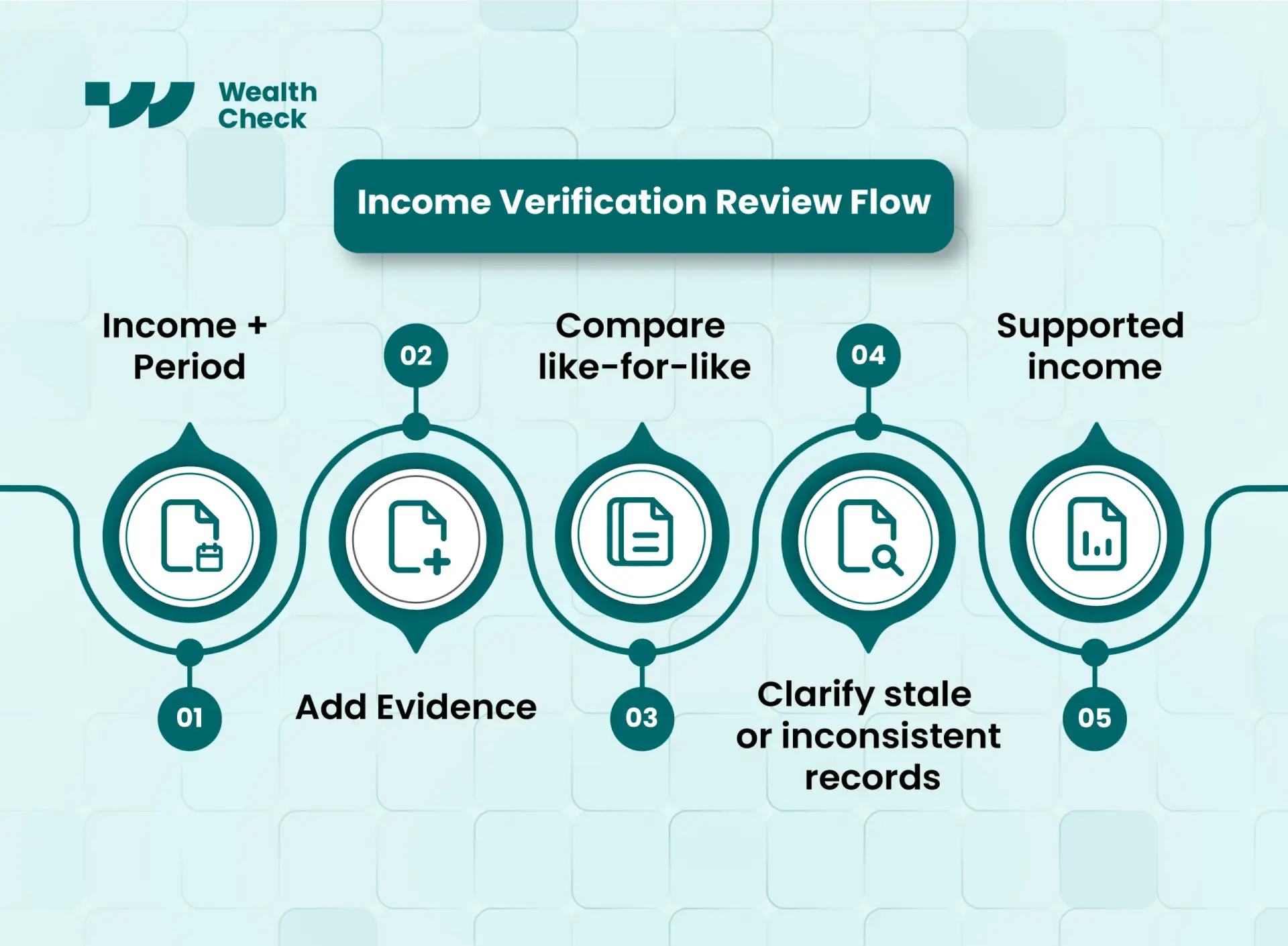
There is no single statutory income verification process used across all organizations. A general check often follows these stages, though some organizations combine or skip parts of the sequence.
- Start with the figure under review. For recent salary, annual earnings, or self-employment income, the requesting organization sets the period and the evidence it will accept.
- Evidence can come from records the applicant provides or from a data source the applicant authorizes, such as account information. Access to one source stays limited to that source and purpose.
- The records are then compared on the same basis. Gross pay and a net deposit, for example, represent different values and should not be treated as equivalent figures.
- If a record is stale, unreadable, or inconsistent with the claim, the case usually moves back to evidence collection for clarification or an updated record.
- The check ends with the income information supported by the evidence, along with any remaining open limits. That result then moves into the wider assessment.
That final step keeps the evidence check separate from the later eligibility or credit outcome.
What Documents Are Used for Income Verification?
The required income documentation depends on the type of income and what the recipient needs to establish. Common evidence includes the following.
| Evidence | Information provided | Important limitation |
|---|---|---|
| Payslip or pay stub | Earnings for a stated pay period and deductions | Gross and net figures differ, and one recent period does not prove future earnings |
| Employer or payroll record | Employment details and, in some cases, earnings | Employment confirmation alone does not always establish the full income amount |
| Tax return or official tax record | Income reported for a tax period | It is historical and does not necessarily describe current receipts |
| Annual earnings statement | Employer or tax information across a year | The form and meaning vary by jurisdiction |
| Bank statement | Observed deposits and account activity | A deposit requires context before it is classified as earned income |
| Business or profit-and-loss record | Evidence relevant to self-employment or business performance | Business revenue is not automatically personal take-home income |
| Benefit or pension record | Award or payment information for a stated program | It is not evidence of employment income |
A document also has to match the question being asked. A contract records the agreed future pay. Income already received requires evidence from a completed period. A tax record reflects historical earnings.
A recent change in employment often necessitates new evidence.
WealthCheck’s Income Verification can use document evidence including payslips, annual salary statements, income or tax statements, and bank statements.
With the customer’s consent, PSD2 Open Banking provides a separate data route. WealthCheck analyzes six months of account transactions through that route. These product inputs do not define the evidence that every other organization must accept.
What Are the Common Methods of Verifying Income?
The verification method follows the source of the evidence. Records supplied by the applicant are handled differently from information obtained directly from an employer, a tax system, or a designated account.
Documents and direct-source records
Applicant-supplied records and direct confirmations enter the check from different sources. Direct confirmation moves the source outside the applicant. The employer or payroll service provides the employment or earnings data; some markets use other authorized employment-data sources.
The fields returned vary by service and market. Tax evidence can be supplied by the applicant or retrieved with authorization, where the system allows. In every case, the record only supports the period it covers.
Permissioned account data
A deposit in the selected account shows that funds have arrived. The organization still has to identify the transaction before treating it as salary. Under EU PSD2 account-information rules, access is limited to the payment accounts designated for the account-information service the user requested.
A case may use more than one route if one source leaves a gap. A historical tax record, for example, might need to be updated after a material change in income.
How Does Income Verification Differ for Employees and Self-Employed Individuals?
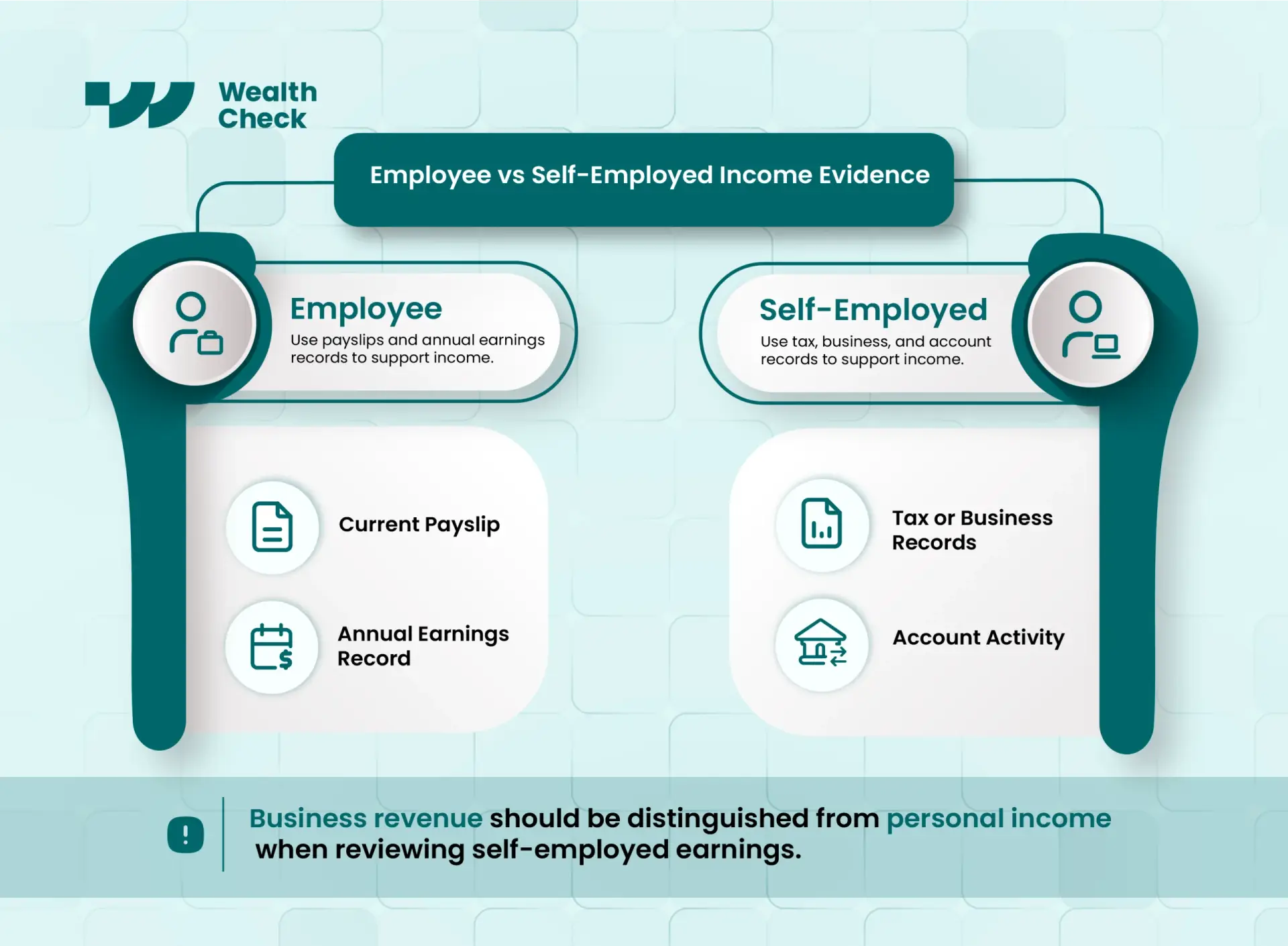
An employee with regular pay usually has a clearer evidence trail. For a current salary figure, a payslip for the same pay period is the starting point.
An annual salary statement provides a longer earnings history, and an employer or payroll record can confirm employment details. Bank statements or permissioned account data show the deposits that reached the account.
Variable pay often calls for several periods because one pay period does not represent the level or stability of earnings used in the assessment.
Self-employed income
Self-employed income is harder to verify because business turnover and personal income are different figures, and there may be no recurring employer record to corroborate the claim. Tax records establish historical income. Business or income statements and account activity add current performance and cash-flow context.
A single high-sales month can overstate the income available to the individual. Reviewing several periods shows how receipts change over time and gives the business a better basis for judging income stability.
The product and underwriting rules set the required history. A mortgage program, for example, may ask for several tax years. Separate evidence is needed for any employment income so the same amount is not counted twice.
How Do Businesses Use Income Verification?
Lenders use verified income as one input in a broader assessment of repayment capacity and credit risk. The figure has to correspond to evidence the lender is prepared to rely on. Expenses and existing obligations still shape the lending decision.
Mortgage lending shows how specific requirements become. EU mortgage-credit rules place income and other financial information within the creditworthiness assessment.
For certain dwelling-secured transactions in the United States, creditors must verify the income or assets on which they rely using reasonably reliable records. Businesses also use verified income in BNPL or leasing assessments, rental decisions, iGaming affordability checks, and other customer-risk reviews. Each use case applies its own rules to the verified figure.
Related concepts
- A verified figure can feed an Affordability Assessment.
- The broader guide to what is affordability explains that a later assessment is made without turning income verification into an affordability calculation.
What Can Complicate the Income Verification Process?
The payslip and bank statement may cover different periods; deductions may reduce the deposit, and a tax return may simply be historical. A recent change in employment can also make new evidence necessary. That is why a mismatch does not always mean the underlying claim is wrong.
- A stale or incomplete record leaves a gap in the evidence. The reviewer will often ask for the missing or updated record before drawing a conclusion from that gap.
- Variable income poses a different problem because commission or self-employment income may require a different evidence period. With multiple income streams, the reviewer also has to check that the same amount is not counted twice.
- If digital access fails, the missing connection says nothing by itself about the person’s income. The case may need another approved evidence route if the organization offers one.
- Some discrepancies stay open until the figures and periods have been traced back to their source. Only then can the reviewer decide what the difference means; the mismatch alone is not a fraud finding.
How Long Does Income Verification Take?
Income verification has no fixed duration. Timing depends on the evidence required and the review needed for the case. The reviewer might already have the account data and still be waiting for an updated payslip or a response from another source.
- Digital records can arrive soon after access succeeds. A missing document or slow third-party response adds time.
- Comparing several periods adds more work, especially in self-employed or mixed-income cases that rely on several records.
- Retrieval time is separate from final review time. Receiving a document or data record quickly does not mean the organization has completed its assessment.
The check finishes after the relevant evidence has been reviewed and any material gap has been addressed.
What Helps Make Income Verification Reliable?
Reliable checks start with a clearly defined income figure and period. Current monthly salary and annual taxable earnings answer different questions. The same is true of a net bank deposit and business revenue.
- First, pin down the figure and period. The record used in the check should support that measure, rather than a related amount from a different basis or time frame.
- Recency matters most after something has changed. A job move or a change in business activity can make an older record poor evidence for the current figure.
- When two figures differ materially, the first task is to work out why. Deductions, payment timing, variable pay, and employment changes are common places to look.
- The case record should capture the evidence supporting the figure and any unresolved points. It should also identify the information carried forward into the next assessment.
Connecting an account does not make its transactions available for unrestricted reuse. The authorization and applicable data rules continue to limit what the organization can access and use.
Gross pay and net receipts describe income at different stages. Disposable and discretionary income belong to later financial analysis, which is covered separately in Disposable vs. Discretionary Income.
Where Income Verification Fits in Financial Assessment
Income verification answers one part of the assessment: what the evidence supports about earnings for a defined period. It does not show how much remains after expenses and debt repayments, or how stable the customer’s finances are. Depending on the decision, the business may also need disposable-income analysis, source-of-funds evidence, and broader credit-risk signals.
WealthCheck combines document evidence with consent-based Open Banking data, then uses these inputs for affordability and broader financial-risk checks. Businesses can use that broader view before making their own lending, rental, affordability, or other risk decisions.
FAQs About Income Verification
What happens when a new business has little tax history?
A new business can reach an income check before it has a long tax history. The recipient then has to decide if the currently available records are sufficient for the period being assessed.
How can cash-paid income be documented?
Cash wages do not create the same direct accounting trail as salary paid into a bank account. The recipient needs other records that tie the claimed earnings to the applicant and the period under review.
Why can’t local income averages verify one person’s income?
An average describes a group, not the applicant. It cannot show what that person earned for the period under review, so the check still needs evidence tied to the individual.
Does extracting data from a payslip mean the income is verified?
Reading the amount is only an extraction. Verification must still establish that the figure belongs to the income claim under review.
Can a tax transcript replace a full tax return?
A transcript may omit details that the recipient needs. Before relying on it, the reviewer must verify that the record contains the information required for that assessment.
Can Income Be Verified Without Pay Stubs?
Income can be verified without a pay stub when another accepted record supports the income type and period under review. For a current salary figure, an employer or payroll record may support the check if the organization accepts that source.
Why Might an Income Verification Request Be Rejected?
A request can be rejected when the evidence cannot support the claimed income for the period being checked. An unreadable or outdated record may need to be replaced first. The organization still makes the final application decision separately.