
An affordability assessment weighs a new payment against living costs and existing obligations. It can apply to a loan installment or another recurring charge.
Rent and loan repayments can use up most of a €4,000 salary before another bill arrives. To judge a new charge, the reviewer needs the amount left after those payments.
A payslip may still include overtime that has ended. If the business relies on that inflated figure, it may judge a new payment manageable even when it would compete with rent or other bills.
Key Takeaways
An applicant’s salary record can be accurate even when an existing repayment leaves little room for another charge.
- Affordability evaluates the proposed payment against money already committed, not salary alone.
- In the table, Applicant B is €50 short after the new payment. That illustrates monthly budget pressure; the calculation supplies no lending approval threshold.
- Groceries and utilities fall outside the DTI numerator. Calculate the ratio using debt payments and gross monthly income, then review those living costs in the budget.
- An account history can omit bills paid elsewhere or reflect a job the applicant has left. Resolve the relevant account and date gaps before relying on it.
- WealthCheck’s document and bank-data reports supply decision inputs; the organization applies its own criteria.
What Does Affordability Assessment Mean?
An affordability assessment checks if a proposed payment fits a person’s budget after living costs and existing obligations are covered.
The amount and timing of a proposed payment matter alongside existing obligations. A loan installment and a recurring service charge can each strain a budget.
A reviewer may find that reported earnings are already committed. This calls for a closer look at the new payment and the provider’s criteria rather than an automatic decision.
A declaration is a starting point. Documents and permissioned account data can help confirm the information, though one incoming payment says little about the person’s other obligations.
Why Is Affordability Assessment Important?
A verified salary can leave little room for another payment after housing costs and existing debt.
- A new installment may compete with rent and basic expenses even if the first payment looks manageable. Omitted commitments can change the result.
- If overtime has ended, an earlier payslip may overstate the money available each month. For seasonal work, the review should cover stronger and quieter earning periods.
In regulated consumer credit, a creditworthiness assessment can be a legal duty before lending. The FCA’s consumer-credit rules require it before regulated agreements and certain significant credit increases. The EBA’s loan-origination guidelines also address loan monitoring after approval; the duties depend on the product and market.
What Is Affordability Assessment Based On?
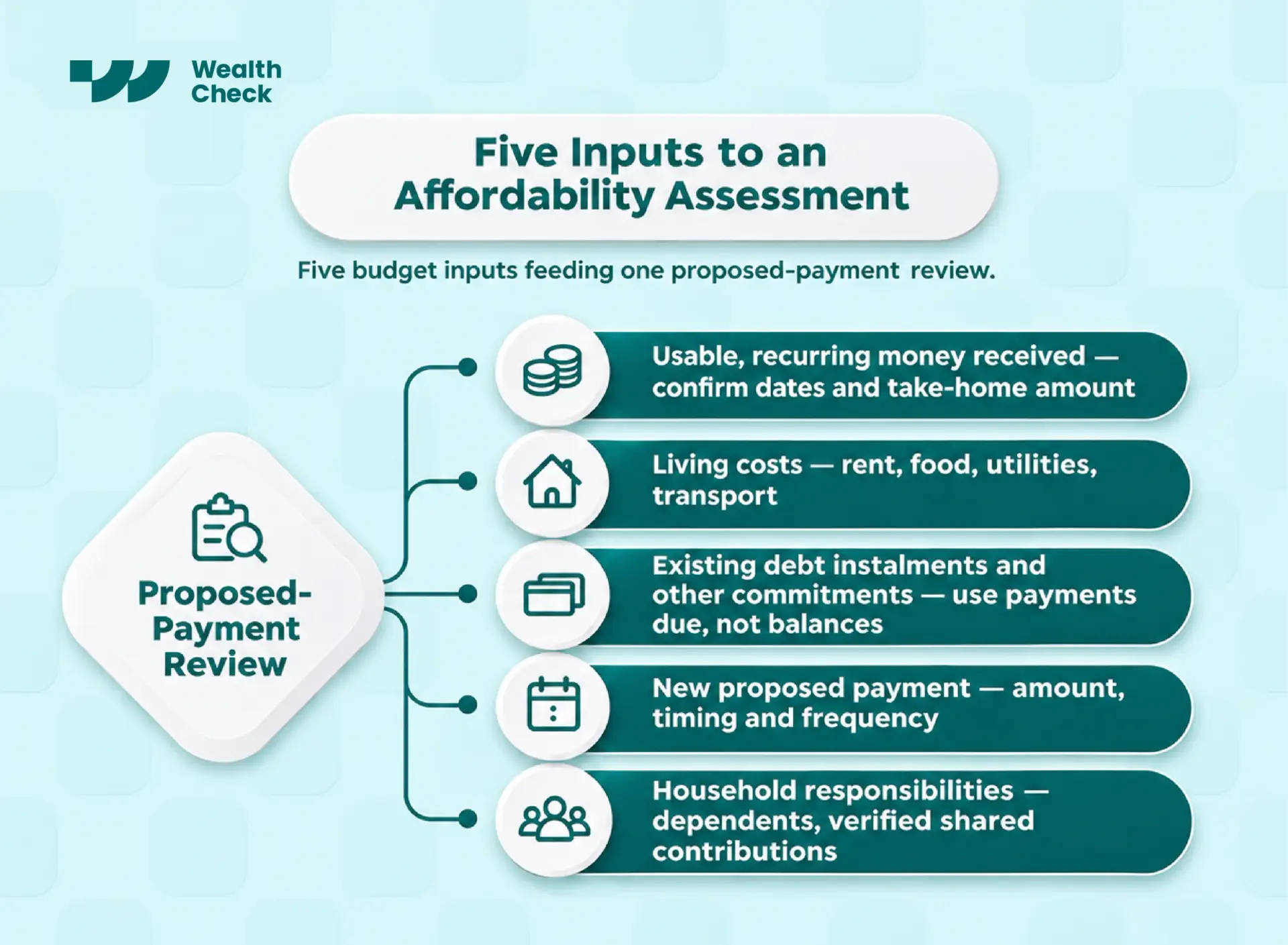
The proposed charge has to fit around bills that are already due. Start with the money the person can use for those bills, then check what is paid out and who is responsible for it.
- Money received: A salary declaration can cover a different period from the matching deposit. Check the dates and payroll deductions to explain the difference, then establish how much take-home pay is usable and likely to recur.
- Living costs: A higher rent reduces what remains for other payments before any food, utility, or transport bill is paid. Dependents add costs too, so the applicant’s household bills are more useful here than a comparison with someone else’s salary.
- Existing payments: A loan statement can show a large outstanding balance but a much smaller installment due this month. Use the repayment falling due in the period under review, together with other continuing obligations, to build the budget.
- The new commitment: Charges falling before payday draw on money that must last until the next pay date. Review how often the proposed charge will recur and any foreseeable change in its amount before adding it to the budget.
- Household responsibilities: Someone paying shared rent may also cover a dependent’s bills. Both draw on the money available for the new charge. A second earner in the household changes the calculation only if their contribution is established; their whole salary cannot simply be counted.
Savings may support an individual payment, but an account balance is not recurring earnings. Transfers between a customer’s own accounts can increase a balance without adding new income.
The factors above describe the budget question. They are not a universal evidence checklist or a single national assessment standard.
How Does Income Affect Affordability?
Both the amount and reliability of earnings matter. A gross annual salary is not the monthly take-home amount available for bills.
The source of income also matters. A deposit for one completed project should not be treated automatically as earnings that will recur next month.
For a reviewer, an invoice, employer record, or matching payment history can help explain the nature of that deposit. A bank credit alone does not label it as wages.
A translator receives €5,000 for a large project after two quiet months. Treating the busy month as normal pay could overstate the money available for regular bills.
Seasonal earnings can vary widely. A useful review reflects that pattern rather than borrowing another lender’s review period.
Compare quieter months with recurring bills. State the review period so a strong earning month does not distort the picture.
How Is Affordability Calculated?
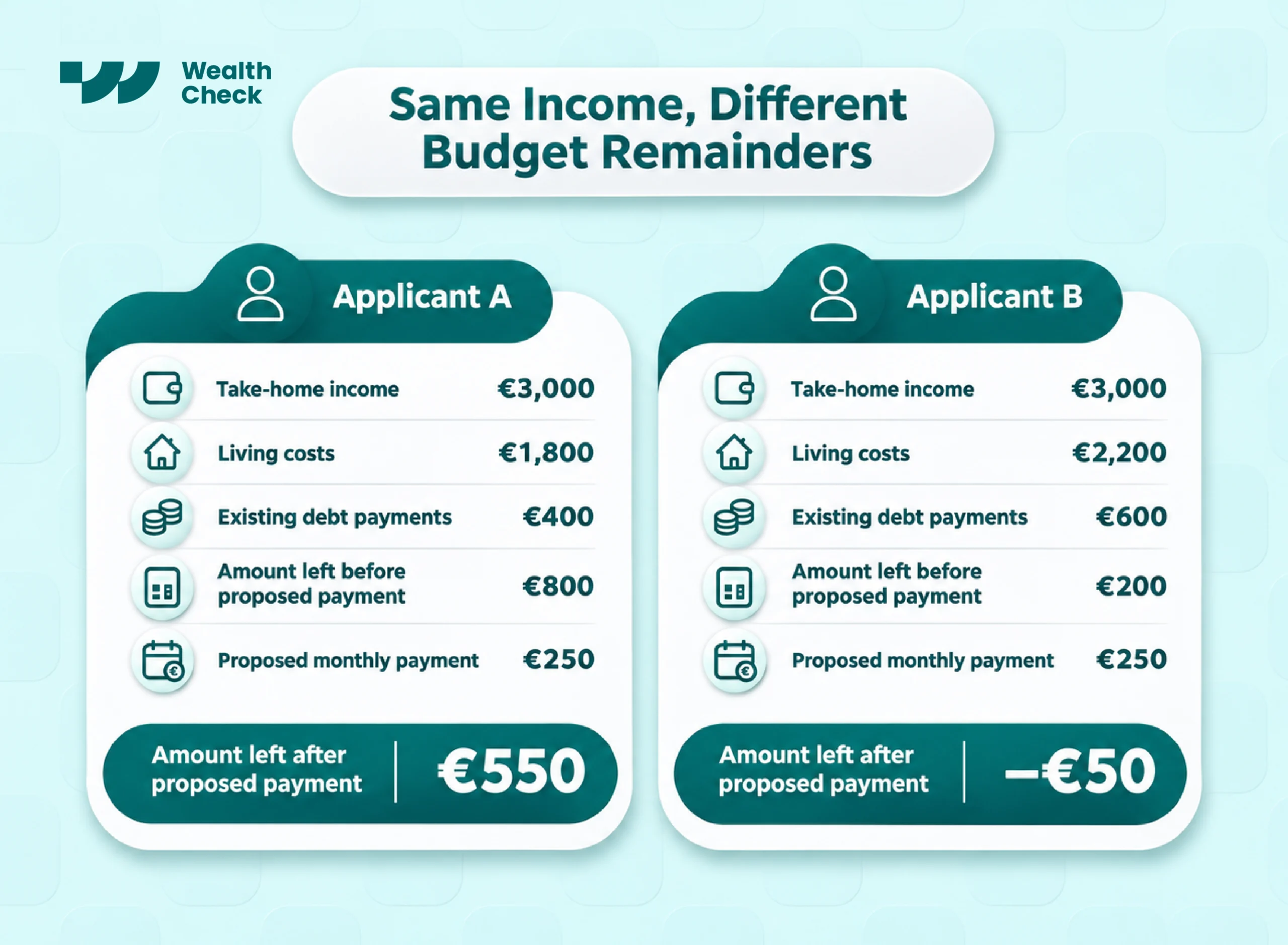
A simple budget comparison subtracts living costs, existing debt payments, and the proposed payment from take-home income. The result is illustrative, not a universal lending formula.
| Monthly budget item | Applicant A | Applicant B |
|---|---|---|
| Take-home income | €3,000 | €3,000 |
| Living costs, excluding debt payments | €1,800 | €2,200 |
| Existing debt payments | €400 | €600 |
| Amount left before new payment | €800 | €200 |
| Proposed payment | €250 | €250 |
| Amount left after new payment | €550 | −€50 |
Applicant A has €550 left after the proposed payment. Applicant B would be €50 short in this simplified month. The difference comes from existing living costs and debt, not income.
These figures are not approval decisions. An annual premium or irregular bill would change the available amount. This monthly remainder is different from the economically disposable personal income.
Which Ratios Help Explain Affordability?
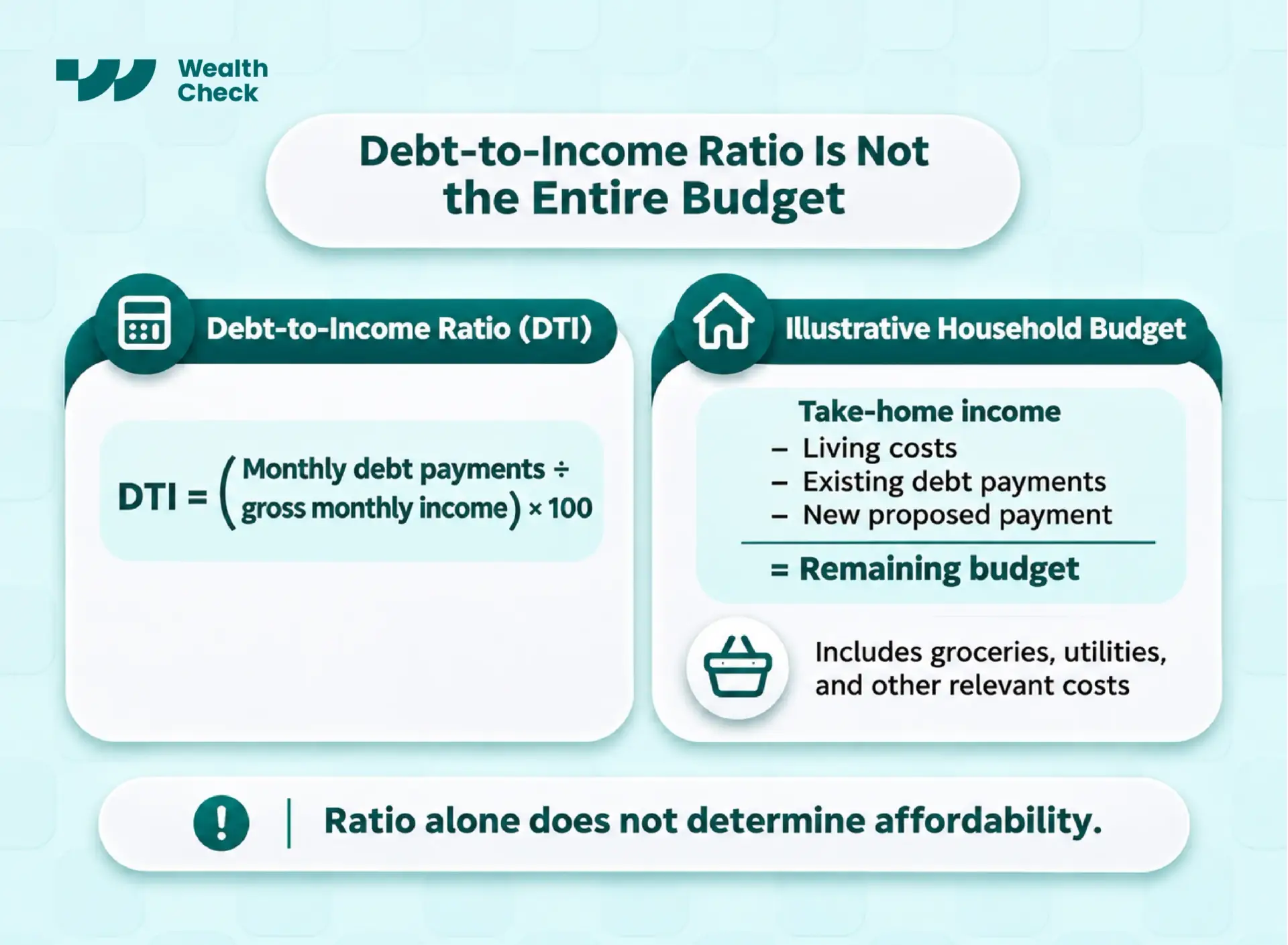
Debt-to-income ratio (DTI) compares monthly debt payments with gross monthly income. It is one way to describe repayment commitments:
DTI = monthly debt payments ÷ gross monthly income × 100
- DTI uses gross income, unlike the take-home figures in the budget example. Groceries, utilities, and other living costs do not appear in its debt-payment numerator.
- Providers and jurisdictions use different criteria. A single DTI percentage cannot be treated as a universal pass mark, and low debt does not necessarily mean low living costs.
The ratio describes debt payments, not the entire household budget. Any useful figure needs a stated period and a clear explanation of its inputs.
How Do Lenders Assess Affordability?
Lenders assess the new repayment against the applicant’s circumstances and their product and market rules. Income is only one input.
- Start with the income verification result, then check which repayments and living costs still have to come out of that income. Verifying earnings leaves that budget question open.
- A payslip can support employment income but may not reveal other debt payments. A bank history may show regular charges while omitting another account’s obligations.
- With suitable permission, open banking can provide account data. Financial documents offer another route of evidence, and reporting tools can help teams organize the findings.
- A large unexplained credit needs clarification before it is treated as regular income. The evidence should establish the payment’s source and the period it represents.
- Future income: A past earnings record may not reflect an anticipated reduction in working hours. The assessment has to use the relevant period and applicable lending policy.
A credit risk assessment may use affordability alongside other repayment-risk information. The lender remains responsible for applying its own criteria and reaching a decision.
How Does Affordability Compare With Ability to Pay?
Affordability and ability to pay often overlap. Some providers use one term for a specific payment and the other for the ongoing budget; that distinction is not universal.
Money in an account may cover the next installment without covering every later one. Someone with steady earnings might face a shortage just before payday.
Eligibility is different again. Meeting a provider’s application criteria does not establish that a payment fits the customer’s budget, and an affordable payment does not guarantee acceptance.
Affordability does not establish where money for a particular transaction came from or how a customer’s wealth accumulated. Source of Funds Verification concerns the origin of the transaction funds; Source of Wealth Assessment examines how the assets were built up. Neither answers how an ongoing payment fits the household budget.
What Is Affordability Assessment Used For?
Organizations use affordability assessments to examine payment pressure. Beyond loans, evidence needs and legal duties differ by provider and market.
Consumer Lending
A provider may compare a new installment with existing debt payments and ordinary living costs.
A substantial credit-limit increase or a buy now, pay later (BNPL) decision can call for a new budget review under applicable rules.
Mortgages
A mortgage lender may use mortgage verification software to examine supporting income documents and the proposed repayment alongside existing obligations. Refinancing may prompt another review under the lender’s criteria.
Rental Screening
A property manager may examine monthly housing costs using the evidence and local rules applicable to that tenancy.
Payment Arrangements
A utility provider arranging overdue-balance repayments needs a plan that fits around living costs. Installments falling before the customer’s payday may be difficult to meet.
Service Commitments
A provider discussing recurring charges can consider the timing of those charges against other household payments, without assuming that formal lender rules apply.
Each assessment needs a clearly identified commitment and evidence that supports its figures. A single result cannot tell the whole financial story.
What Can Change a Customer’s Affordability?
A lower debt payment or recurring expense can free up money. An application cannot change the underlying budget on its own.
- A customer with variable earnings may use savings from stronger months to pay bills during quieter periods. Budgeting for quarterly or annual bills also exposes costs absent from a single month’s statement.
- An applicant may correct inaccurate income or expense figures while still disclosing existing obligations. The updated figures may change the assessment, but do not guarantee approval.
What Should Businesses Conclude From an Affordability Assessment?
For a proposed charge, the business needs to know what the customer must pay from the same income. A salary record alone can miss a repayment, and bills paid from another account can be absent from the history supplied.
Clarify unexplained transactions rather than treating them as fraud. A budget remainder informs a decision; it cannot predict every future payment.
WealthCheck draws together bank-data inputs and financial documents for an organization reviewing a customer’s finances. The organization can use the resulting financial assessment to examine a proposed payment, then apply its own criteria to the affordability assessment and retain the final decision.
Explore WealthCheck to see how a financial health check can add context to the payments customers already face.
FAQs: What Else Should You Know About Affordability Assessment?
An affordability review may still leave gaps in account coverage or shared household bills. Those issues can affect the final decision even when the income figure has been checked.
What Happens After an Affordability Assessment?
The provider reviews the proposed payment, the customer’s available income, and the evidence behind existing bills and debt. It may ask for more records, offer different terms, approve the request, or decline it under its policy.
An affordability finding is one part of the decision. The provider may need to reassess the figures if income or expenses change, and a positive finding does not guarantee approval.
Can savings be considered during an affordability assessment?
Savings can matter if the customer intends to use them for a payment. A €5,000 balance is different from €5,000 earned every month, and spending it reduces what remains.
Providers decide how assets count under their applicable rules. An assessment should separate funds held today from income expected to recur.
How recent should the financial information be?
No single document-age limit applies to every affordability review. A change in work or borrowing may make older evidence less useful, even if it was accurate.
After a job change, updated earnings records may tell the reviewer more about current finances than older payslips from a previous employer.
Does information from one bank account show the full picture?
Not always. Income may arrive in another account, while debts or regular bills are paid elsewhere. One account can be useful without providing every relevant obligation.
A team should review the scope of the data received and seek clarification about gaps that affect the commitment. Missing information alone does not prove fraud.
For example, regular cash withdrawals may indicate spending without naming the expense. A reviewer should not assign those withdrawals a purpose that the evidence cannot establish.
How should shared household costs be treated?
Two adults split the rent, but one pays most of the other bills. An equal split of every expense would understate that person’s costs. Use the portion the applicant actually pays, including those additional household payments.
Do not automatically count another household member’s income. Joint resources and responsibilities depend on the facts, provider policy, and applicable rules.
A shared rent payment also requires attention to who is contractually responsible and who actually pays. Those amounts may differ in practice.
How Can Affordability Be Assessed Without Open Banking?
Financial documents can support an assessment without a bank-data connection. Each provider selects evidence according to its product, policy, and permitted access routes.
WealthCheck describes both document and bank-data inputs. That does not mean every customer must connect a bank account or that one account shows all commitments.
Why Might Two Lenders Reach Different Affordability Findings?
Two lenders may review different payment amounts, repayment periods, or evidence. Their assessment policies may also differ, so identical income can produce different findings.
Gaps still need to be resolved before a lender treats its findings as settled. A positive affordability review does not guarantee another lender’s approval.